The Role of Automation in Compliance Management
Regulatory updates
Audit-readiness
Regulatory compliance in the European Union has always been serious. But something has changed in the last two years that makes the old approach genuinely unsustainable. The volume of overlapping, interconnected regulations now in force across the EU means that compliance is no longer a periodic exercise your team completes before an audit and forgets about until the next one. It is a continuous operational discipline that touches almost every function of your business, every single day.
And yet, most compliance teams are still running this discipline the same way they were a decade ago. Spreadsheets. Email trails. Manual evidence gathering. Point-in-time assessments. A calendar reminder for when the next review is due. This approach worked when there were fewer frameworks, slower enforcement, and more time. Right now, it is a liability.
Compliance automation is the structural response to this reality. Not a silver bullet, not a way to sidestep legal expertise, but a genuine operational shift that is helping regulated businesses move from reactive, evidence-scrambling compliance to something much more resilient: continuous, audit-ready, always-on compliance management.
This article covers what compliance automation actually is, what the EU regulatory environment currently demands of your organisation, what automation does and does not solve, where its impact is greatest across different sectors, and how to approach implementation in a way that actually works.
What Is Compliance Automation, and What Isn't It?
Compliance automation refers to the use of technology, typically software platforms like SpeedyDD, AI-assisted tools, and integrated workflow systems, to automatically collect evidence, monitor controls, detect gaps, generate reports, and alert teams to regulatory risks. Done well, it takes the most time-consuming, error-prone parts of compliance management and makes them continuous and reliable instead of periodic and fragile.
What it is not: a replacement for human judgement, legal expertise, or a properly structured compliance function. Automation does not tell you what your obligations are. Your lawyers, your Data Protection Officer, and your compliance officers do that. What automation does is make sure that once you know what you need to do, you are actually doing it, consistently, and that you can prove it when a regulator or auditor asks.
A useful analogy here is smoke detection. A smoke detector does not prevent fires. It does not tell you where your flammable materials are stored or whether your staff have completed fire safety training. What it does is monitor continuously, alert you immediately when something changes, and provide a timestamped log showing the system was functioning. Without it, you rely entirely on someone remembering to check. That is the difference between reactive and proactive compliance, and it is exactly the shift that automation enables.
The practical implication of this distinction matters enormously when you are setting expectations internally. Compliance automation will not reduce the need for qualified compliance staff. In most organisations, it makes those staff more effective by removing the administrative burden that currently consumes the majority of their working hours.
The EU Regulatory Environment in 2026: What Your Organisation Is Actually Facing
To understand why compliance automation has moved from a niche capability to a mainstream operational necessity, you need to understand the specific regulatory environment EU businesses are now operating in. It is genuinely unlike anything that came before it, in terms of breadth, enforcement intensity, and the pace of new obligations coming into force.
GDPR (General Data Protection Regulation) (Regulation (EU) 2016/679) remains the cornerstone of EU data compliance and is actively enforced. Fines of up to €20 million or 4% of global annual turnover apply, whichever is higher. The obligation to maintain records of processing activities, manage consent, respond to data subject requests within strict timelines, and report breaches to supervisory authorities within 72 hours creates ongoing, evidence-heavy demands that are fundamentally difficult to manage manually at any meaningful scale.
DORA (Digital Operational Resilience Act) (Regulation (EU) 2022/2554) has applied to financial entities and their critical ICT service providers since January 2025. It mandates continuous ICT risk management, incident classification and reporting within very tight timeframes (initial notification within 24 hours of classification), regular digital resilience testing, and detailed third-party ICT provider management. These are not annual checkbox requirements. They require systems and processes that run continuously.
NIS2 Directive (Directive (EU) 2022/2555) came into effect across EU Member States in October 2024 and significantly expanded the scope of entities covered compared to its predecessor. Energy, transport, healthcare, banking, digital infrastructure, water management, and public administration are all within scope. NIS2 requires robust cybersecurity risk management frameworks, incident detection and reporting capabilities, and supply chain security measures. Importantly, senior management can now be held personally liable for non-compliance.
The EU AI Act (Regulation (EU) 2024/1689) entered into force in August 2024 and is being phased in through 2027. From August 2025, binding obligations apply to providers of General Purpose AI models. For organisations deploying high-risk AI systems, the Act requires conformity assessments, technical documentation, human oversight mechanisms, and ongoing logging of system behaviour. Non-compliance can result in fines of up to €35 million or 7% of global annual turnover.
The AMLR (Anti-Money Laundering Regulation) and the EU AML Authority (AMLA) are reshaping customer due diligence requirements across financial services. AMLA brings harmonised, European-level scrutiny to AML compliance programmes. Identity verification, beneficial ownership checks, and ongoing transaction monitoring are all areas where automation provides both accuracy and auditability that manual processes cannot consistently deliver.
The EU Data Act (Regulation (EU) 2023/2854) became fully applicable in September 2025, introducing new data-sharing obligations and governance requirements for organisations dealing with IoT-generated data.
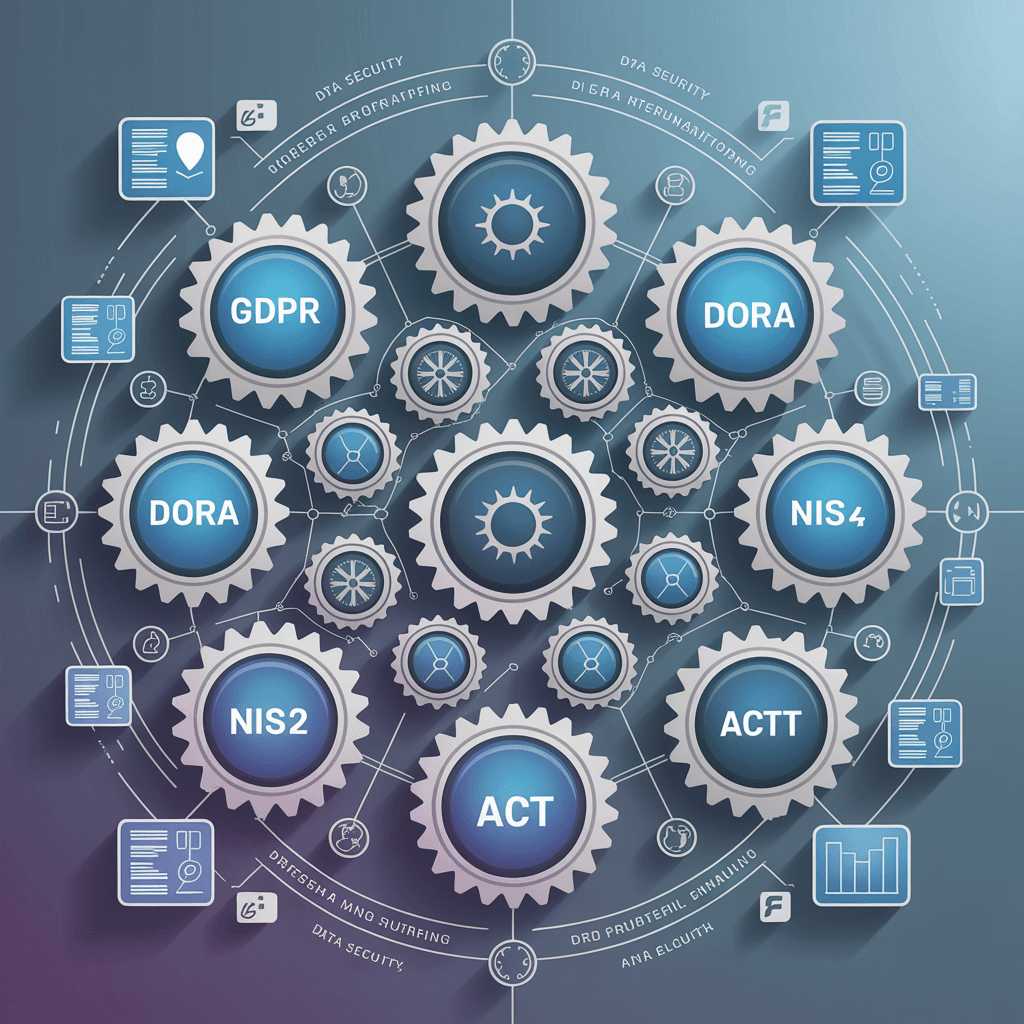
The central challenge that the combination of these frameworks creates is not any single regulation in isolation. It is the overlap. Data protection requirements appear in GDPR, DORA, NIS2, and the AI Act simultaneously. Incident reporting obligations appear in DORA and NIS2 with different but related timelines. Risk assessment obligations span DORA, NIS2, the AI Act, and sector-specific frameworks. Without automation, compliance teams end up performing versions of the same work four or five times over, for different frameworks, often with inconsistent results. This is where significant compliance gaps actually emerge, not from a lack of intent, but from the sheer operational complexity of managing multiple overlapping frameworks manually.
What Compliance Automation Actually Does: The Core Capabilities
When people refer to compliance automation, they are typically describing a set of interconnected capabilities that together make compliance management continuous rather than periodic. Here is what those look like in practice.
Continuous Control Monitoring
Rather than testing controls quarterly or annually, automation platforms monitor them in real time. If a system configuration changes, an access permission lapses, a certificate expires, or a policy document passes its review date, the platform flags it immediately. This is the difference between knowing you were compliant last quarter and having confidence that you are compliant right now, which is what regulators increasingly expect.

For DORA-regulated entities in particular, this kind of continuous monitoring is not a best practice. It is a requirement. DORA's ICT risk management framework mandates ongoing identification, classification, and monitoring of ICT risk, which is operationally impossible to maintain manually across a complex technology estate.
Automated Evidence Collection
Preparing for an audit used to mean weeks of gathering screenshots, logs, policy documents, and access records manually. Automation platforms integrate with your existing systems, including cloud environments, HR tools, identity management, and security software, and pull evidence continuously. When an audit arrives, the evidence is already there, correctly labelled, timestamped, and mapped to the relevant control.
Framework Mapping and Overlap Management
One of the most immediately practical benefits for regulated businesses is cross-framework control mapping. Modern GRC platforms can map a single control to multiple regulatory frameworks simultaneously. Access logging, for example, may satisfy requirements under GDPR, NIS2, ISO 27001, and DORA at the same time. Without automation, teams often re-implement similar controls separately for each framework. With it, you implement once and map everywhere, significantly reducing duplication and the inconsistency that duplication produces.
This is particularly valuable as organisations come to terms with the overlapping scope of GDPR, DORA, NIS2, and the AI Act. Mapping controls across all four frameworks manually, maintaining that mapping as regulations evolve, and keeping evidence current for all of them simultaneously is not realistically achievable without technology support.
Risk Assessment and Prioritisation
Automated platforms continuously assess risk across your control environment, surfacing issues by severity and regulatory impact. Rather than a compliance officer manually reviewing every notification, the system identifies the issues that actually require human attention. This reduces alert fatigue and ensures that human judgement is applied where it genuinely adds value, rather than being consumed by administrative filtering.
Regulatory Change Monitoring
In the current EU legislative environment, this capability is critically underappreciated. The AI Act, DORA, NIS2, the Data Act, and the AMLR have all either entered into force or are activating key provisions within a two-year window. Tracking how each of these changes affects your existing control framework manually, and doing so before the relevant deadline passes, is a significant operational challenge. Compliance automation platforms that include regulatory change monitoring can alert you when your obligations shift, giving you lead time to adapt rather than discovering the gap when a regulator does.
Audit Trails and Reporting
Every action, review, approval, and remediation in an automated compliance platform is timestamped and logged. This creates an immutable audit trail that regulators, auditors, and senior management can review. Under DORA, NIS2, and the AI Act, the ability to demonstrate that your compliance programme was functioning at a specific point in time, and to produce that evidence quickly, is a compliance requirement, not simply a matter of good housekeeping.
Where Compliance Automation Has the Greatest Impact
While the benefits of compliance automation apply broadly, certain sectors face a combination of regulatory complexity and operational intensity that makes the case for automation particularly clear.
Financial Services: DORA, MiFID II, and AML
Financial institutions in the EU operate under a layered compliance burden that is genuinely unmanageable without significant technology support. The combination of DORA's ICT resilience requirements, MiFID II's best execution and transaction reporting obligations, and AML customer due diligence requirements creates continuous, overlapping demands for evidence and documentation. 80% of European financial institutions rely on GRC software to meet regulatory requirements, according to data cited by the European Central Bank. For financial entities now subject to DORA, that figure is likely to increase further as the regulation's requirements for ICT risk management and third-party oversight become embedded in supervisory expectations.
Healthcare and Life Sciences
Healthcare organisations must navigate GDPR's special category data provisions, which impose significantly stricter requirements on health data than on ordinary personal data. NIS2 explicitly covers healthcare entities following a series of high-profile ransomware incidents at hospitals across EU Member States in 2023 and 2024. Medical Device Regulation (MDR) and In Vitro Diagnostic Regulation (IVDR) add further layers of documentation and conformity assessment. In environments where compliance failures can have direct patient safety implications, continuous monitoring and automated evidence collection are not just operationally valuable. They are genuinely critical.
Technology and Digital Services
SaaS companies, cloud service providers, and any organisation that processes EU residents' data at scale faces the converging demands of GDPR, the EU Data Act, and the AI Act simultaneously. For businesses growing quickly across markets, the compliance overhead of manually managing these frameworks at scale becomes prohibitive. Automation, particularly AI-assisted framework mapping and continuous control monitoring, is increasingly the only scalable approach.
Professional Services and Consulting
Professional services firms subject to AML obligations, particularly those providing legal, accounting, or financial advisory services, face ongoing customer due diligence requirements that benefit enormously from automation. Automated identity verification, beneficial ownership checks, and ongoing monitoring of client risk profiles both speed up onboarding and create the evidence trail that supervisory authorities increasingly expect to see.
Common Misconceptions About Compliance Automation
It is worth addressing some of the misconceptions that lead organisations to either over-invest in automation without the right foundations, or to dismiss it as something they do not yet need.
"Automation means we do not need compliance expertise." This is incorrect and potentially dangerous. Automation amplifies what a skilled compliance team can achieve. It does not replace the need for people who understand your regulatory obligations, can interpret legal changes, and can make contextual judgements about risk. The technology works best when it is configured and overseen by people who know what they are doing.
"Once we automate, we are covered." Compliance is a continuous process, not a state you reach and maintain without effort. Automation makes it continuous, which is more rigorous than annual point-in-time audits. But it requires ongoing configuration, review, and maintenance to stay aligned with evolving regulations and your organisation's changing technology and business environment.
"Automation is only for large enterprises." This was true when GRC platforms required large IT teams to implement and maintain. Cloud-based solutions have changed this significantly. Many platforms are now accessible to mid-market and smaller businesses, which matters particularly as NIS2 and DORA extend compliance obligations to a much broader range of entities than previous frameworks covered.
"We will automate once we have sorted out our compliance programme manually first." In practice, organisations that wait for perfect manual compliance before automating almost never automate. The practical approach is to begin automating evidence collection and control monitoring early, using the visibility this creates to identify gaps, rather than trying to map everything manually before touching technology.
Practical Steps for Getting Started
If your organisation is beginning to evaluate compliance automation, the following approach reflects what tends to work in practice for EU-regulated businesses.

Start with an honest gap analysis. Before implementing any technology, map your current compliance obligations against your existing controls. Identify where evidence gaps exist, where manual processes are creating delays or inconsistency, and where you have overlapping requirements across multiple frameworks. This is the foundation that everything else builds on, and it will also help you evaluate which platforms are actually suited to your regulatory environment.
Do not automate a broken process. Automation makes existing processes faster and more consistent, for better or worse. If your control framework has gaps, or your policies are outdated, address those first. Automating a flawed process scales the flaw.
Prioritise integration with your existing systems. The value of compliance automation depends heavily on its ability to pull data from your actual technology stack, including your cloud infrastructure, identity management, HR platform, and security tooling. A platform that does not integrate with your environment creates more manual work, not less.
Build for auditability from day one. Every configuration decision, policy approval, and remediation action should be logged within the platform. Under DORA, NIS2, and the AI Act, the ability to demonstrate that your compliance programme was functioning at a specific point in time is a requirement, not just good practice.
Assign ownership, not just access. Compliance automation surfaces issues and assigns them to control owners. Make sure ownership is clearly defined within your organisation so that automated alerts result in actual remediation action rather than just notifications that sit unread.
Plan for regulatory change. Your compliance obligations in 2027 and 2028 will look different from today's. Choose platforms and build processes that can adapt to new frameworks and evolving requirements, rather than those optimised only for your current regulatory footprint.
What Good Looks Like: Continuous Audit-Readiness
The phrase "audit-ready" used to mean spending months preparing for an audit that might happen once a year. With compliance automation done well, it means something different: your evidence is always current, your controls are continuously monitored, and your documentation is always complete.
For EU-regulated businesses, the move to continuous audit-readiness also reduces exposure to the enforcement risk that comes with the EU's increasingly active supervisory environment. According to PwC's Global Compliance Survey 2025, 42% of executives said that investments in compliance technology resulted in increased trust from stakeholders. In a regulated industry, that trust, from customers, partners, supervisors, and investors, is a meaningful competitive advantage.
About SpeedyDD
At SpeedyDD, our mission is to help complex, regulated businesses achieve and maintain continuous audit-readiness without the operational burden that traditionally comes with it. We understand that for businesses navigating overlapping EU regulatory frameworks, compliance is not a once-a-year project. It is a constant operational reality. SpeedyDD is built for exactly that: bringing together the people, processes, and technology needed to keep your compliance posture current, evidenced, and regulator-ready at all times. If your business is subject to GDPR, DORA, NIS2, AML requirements, or the EU AI Act, we would welcome the conversation. Learn more about us here
Frequently Asked Questions
What is the difference between GRC platforms and compliance automation tools?
GRC (Governance, Risk, and Compliance) platforms are typically broader in scope, covering risk management, policy management, and governance alongside compliance. Compliance automation tools often focus more narrowly on evidence collection, control monitoring, and audit preparation. In practice, the categories overlap significantly, and many modern platforms do both. For EU-regulated businesses, the practical question is whether the tool can map to your specific regulatory frameworks and integrate with your existing systems.
Does compliance automation cover third-party and supply chain risk?
Increasingly, yes. Third-party risk management (TPRM) is a growing capability within compliance automation platforms, and it is particularly relevant for EU businesses right now. DORA explicitly requires financial entities to manage ICT third-party risk, including maintaining a register of ICT service providers. NIS2 requires organisations to address security within supply chains. The Corporate Sustainability Due Diligence Directive (CSDDD) extends obligations to business partners' operations. Modern GRC platforms can automate vendor questionnaires, track supplier compliance status, and integrate third-party risk data into your overall risk picture.
How does compliance automation support GDPR specifically?
GDPR compliance requires maintaining records of processing activities, managing consent, handling data subject requests within strict timelines, and reporting breaches to supervisory authorities within 72 hours. Automation can maintain your Article 30 records of processing activities (RoPA) continuously, alert you when a data subject access request is approaching its one-month deadline, and generate breach notification documentation in a structured, auditable format. It does not replace your Data Protection Officer, but it makes their work significantly more manageable and defensible.
What does the EU AI Act require in terms of compliance documentation?
For organisations using high-risk AI systems as defined under Annex III of the AI Act, the Act requires technical documentation, conformity assessments, ongoing logging of AI system behaviour, and human oversight mechanisms. For General Purpose AI model providers, obligations around transparency, copyright compliance, and cybersecurity became binding from August 2025. Compliance automation, specifically automated documentation and operational logging, is one of the most practical ways to meet these ongoing requirements without prohibitive manual overhead.
Can smaller businesses afford compliance automation?
The market has changed significantly. Cloud-based GRC platforms are available at a range of price points, and many are specifically designed for mid-market and smaller businesses. The more important question is often whether a smaller business can afford not to automate. Under NIS2, many medium-sized entities in essential sectors now carry legal obligations that were previously only imposed on large organisations. Under GDPR, there is no size-based exemption from data breach notification requirements or data subject rights obligations. The cost of a significant compliance failure, including regulatory fines, reputational damage, and emergency remediation, almost always exceeds what a well-chosen automation platform would have cost over several years.
How does compliance automation handle regulatory changes?
This varies by platform. Some GRC tools include built-in regulatory content libraries that are updated when regulations change, automatically flagging which of your existing controls may be affected. Others require manual updates to reflect regulatory changes. Given the current pace of EU regulatory activity, with the AI Act, Data Act, DORA, and AMLR all activating within a compressed timeframe, this capability matters significantly. When evaluating platforms, ask specifically how regulatory updates are managed, who is responsible for keeping content current, and how quickly the platform has historically reflected meaningful regulatory changes in your sector.
What is continuous compliance, and how is it different from traditional compliance?
Traditional compliance is periodic: you complete an annual audit, prepare evidence for a defined review period, receive a certification or report, and in many organisations compliance activity then winds down until the next cycle. Continuous compliance means your controls are monitored in real time, evidence is collected automatically and on an ongoing basis, and your compliance posture is always current rather than current as of the last audit date. For EU-regulated businesses subject to DORA's 24-hour incident notification requirement or NIS2's 72-hour reporting deadline, continuous compliance is not an aspiration. It is the only realistic way to meet those obligations consistently.
How does compliance automation support audit preparation?
When your compliance programme is automated, audit preparation changes fundamentally. Instead of spending weeks gathering and organising evidence, your team is verifying that the continuously collected evidence is complete, correctly labelled, and mapped to the right controls. Audit packages can be generated in a fraction of the time. Regulators and auditors increasingly expect to see automated, timestamped evidence rather than manually assembled spreadsheets, and that expectation is likely to harden further as compliance automation becomes standard practice. The goal is a state where audit preparation takes hours rather than months.
What should I look for when evaluating a compliance automation platform for an EU-regulated business?
At a minimum, look for coverage of your specific regulatory frameworks, whether GDPR, DORA, NIS2, the AI Act, or AML as applicable. Look for integration capability with your existing technology stack. Look for built-in or regularly updated regulatory content. Look for a clear and immutable audit trail for all evidence and actions. Look for third-party risk management capabilities if relevant to your sector. Look for a credible data residency and security posture that meets your own compliance obligations, because a compliance platform that creates compliance problems is self-defeating. Be cautious of platforms that claim to "solve" compliance without requiring significant configuration or ongoing expertise. Compliance is inherently context-specific, and generic solutions rarely hold up under serious regulatory scrutiny.
How does management liability under NIS2 affect compliance automation decisions?
NIS2 introduced personal liability for senior management in entities within its scope, meaning executives and board members can be held individually responsible for compliance failures in certain circumstances. This has changed the internal conversation around compliance investment significantly. When the downside of a compliance failure is not just an organisational fine but potential personal liability for leadership, the business case for investing in robust, continuously monitored compliance infrastructure becomes considerably easier to make. Compliance automation provides the kind of documented, timestamped evidence of an active and functioning compliance programme that is relevant not just to regulatory audits but to demonstrating management accountability.