The 5 Best Compliance Document Management Platforms in 2026
Document management
Most businesses do not think of their document management platform as a compliance control. They think of it as infrastructure, the place where files live, somewhere between an IT procurement decision and an afterthought. For a regulated business, that framing is a mistake, and it is one of the most common reasons compliance programmes fail under audit.
Every KYB file, every UBO declaration, every approval record, every renewal alert your compliance team relies on lives inside whatever document management system you have chosen, deliberately or by default. When a regulator asks you to produce a complete, timestamped, attributable record of a counterparty relationship, the platform holding that record determines whether you can answer in minutes or whether you spend three weeks reconstructing it from email threads and shared drives.
This guide compares the five platforms best suited to compliance document management for regulated businesses in 2026, specifically through the lens of what matters most under regulatory scrutiny: centralised, registry-sourced verification data, structured workflow enforcement, immutable audit trails, automated renewal tracking, and the ability to scale across multiple jurisdictions without losing consistency. We have evaluated each platform on the same criteria and included a direct comparison table after each individual breakdown, so you can see exactly where each platform is strongest and where it has limitations.
A note on methodology: every claim made about a competitor platform in this guide is drawn from publicly available product information and third-party reviews, current as of 2026.
1. SpeedyDD
Overview
SpeedyDD is a KYB onboarding and compliance management platform purpose-built for regulated businesses that need continuous audit-readiness, not just a place to store onboarding documents. It is built specifically around the problem most compliance document management tools were never designed to solve: making every business relationship, in every jurisdiction, demonstrably compliant on demand, not just compliant in theory.
What Sets It Apart
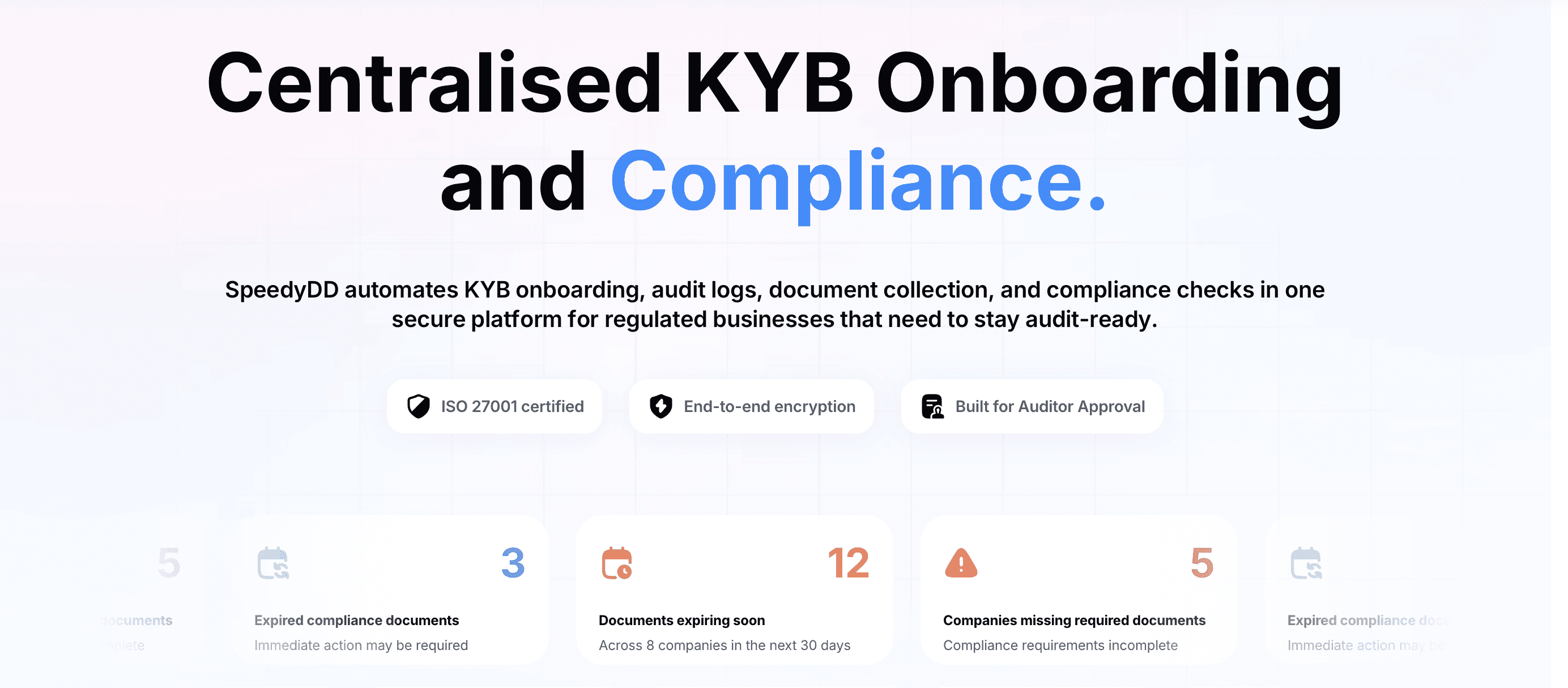
The foundation of SpeedyDD's approach is registry-sourced verification rather than reliance on self-declared documentation. SpeedyDD connects with over 3000 corporate registry data sources across more than 200 countries and territories, meaning the company data underpinning your KYB files comes from primary regulatory and registry sources rather than relying solely on what a counterparty chooses to submit. For regulated businesses operating under frameworks like the EU's Anti-Money Laundering Regulation, which requires obliged entities to collect valid proof of registration or a recently issued register excerpt for every new business relationship, this distinction between self-declared and registry-verified documentation is not a nice-to-have. It is the evidentiary standard regulators are increasingly applying.
Where SpeedyDD differentiates most clearly from general-purpose document management and identity verification platforms is in how it treats audit-readiness as a default output rather than a feature to configure. Document collection, risk classification, approval hierarchies, expiry tracking, and ongoing monitoring are built around producing a complete, timestamped, attributable record automatically, for every counterparty relationship, rather than requiring compliance teams to manually assemble that evidence when an audit is announced.
Best For
Regulated businesses operating across multiple jurisdictions including PSPs, EMIs, CASPs, and iGaming operators that need a centralised KYB and due diligence infrastructure capable of meeting the documentation and evidentiary standards of EU, US, and APAC regulatory frameworks simultaneously, without maintaining separate compliance processes for each market.
Limitations to Consider
SpeedyDD is purpose-built for KYB, due diligence, and audit-readiness rather than functioning as a general-purpose enterprise document management system covering unrelated business documentation outside the compliance and verification context. Businesses looking for a single platform to manage all internal corporate documentation, not specifically compliance and counterparty verification records, should evaluate SpeedyDD alongside, rather than instead of, broader enterprise content management infrastructure.
2. Sumsub
Overview
Sumsub is a well-known verification platform that combines business checks, identity checks, and AML screening into one onboarding flow. It is popular with fintech and crypto companies for being fast and easy to plug into a product.
What It Does Well
Sumsub can check over 14,000 document types from more than 220 countries, using a mix of optical scanning and AI to read and confirm documents. Its workflow builder lets compliance teams set up or adjust their onboarding rules by country or risk level without needing a developer every time. For crypto exchanges in particular, Sumsub supports the FATF Travel Rule, a global standard requiring crypto businesses to share sender and receiver information on transactions, which is a real advantage for that specific industry. In early 2026, Sumsub also added a partnership with ComplyAdvantage, giving its AML screening access to fresher financial crime data.
Limitations
Sumsub is built primarily as a fast decision engine for onboarding, not as a long-term home for document records and audit history. It is strong at saying yes or no quickly. It is less suited to businesses whose biggest need is a deep, ongoing paper trail across years of a relationship, especially one verified directly against government registries rather than submitted documents.
3. Trulioo
Overview
Trulioo is a Canadian identity verification company, founded in 2011, that checks both people and businesses across 195 countries using more than 450 data sources. It handles identity checks, business checks, and AML screening through one platform.

What It Does Well
Trulioo's biggest strength is reach. It covers a huge number of countries, which makes it a solid choice for larger companies operating in markets where the rules and paperwork differ a lot from place to place. Its workflow tool lets teams build onboarding flows for different countries and risk levels without writing code, and it includes dashboards that give some visibility into verification activity over time.
Limitations
Like Sumsub, Trulioo is built first as a verification tool, meant to check someone at the moment they sign up. It is not primarily designed to be the long-term filing system for ongoing compliance documents, like tracking when a document needs renewing two years into a relationship. Businesses that need that kind of long-term recordkeeping usually need to add something else alongside it.
4. Binderr
Overview
Binderr is a KYB platform that also publishes its own research comparing different KYC and KYB tools, which gives it a solid view of what businesses across the industry actually need from an onboarding and verification system.
What It Does Well
Binderr's product is built around structured, customisable onboarding flows for regulated businesses, letting compliance teams shape the checks they run based on the type of business, the country, and the level of risk involved. The company's deep familiarity with the wider market, shown through its own research and comparisons, suggests a strong understanding of where most KYB tools fall short and where businesses tend to need more support.
Limitations
There is less public, independently confirmed detail available about Binderr's own document storage and audit trail setup compared to some of the larger, more established names in this space. If you are considering Binderr, it is worth asking directly for a demo focused specifically on how long documents are kept, how renewals are tracked over time, and how detailed the audit trail actually is, since this information was harder to confirm independently at the time of writing.
5. Ondato
Overview
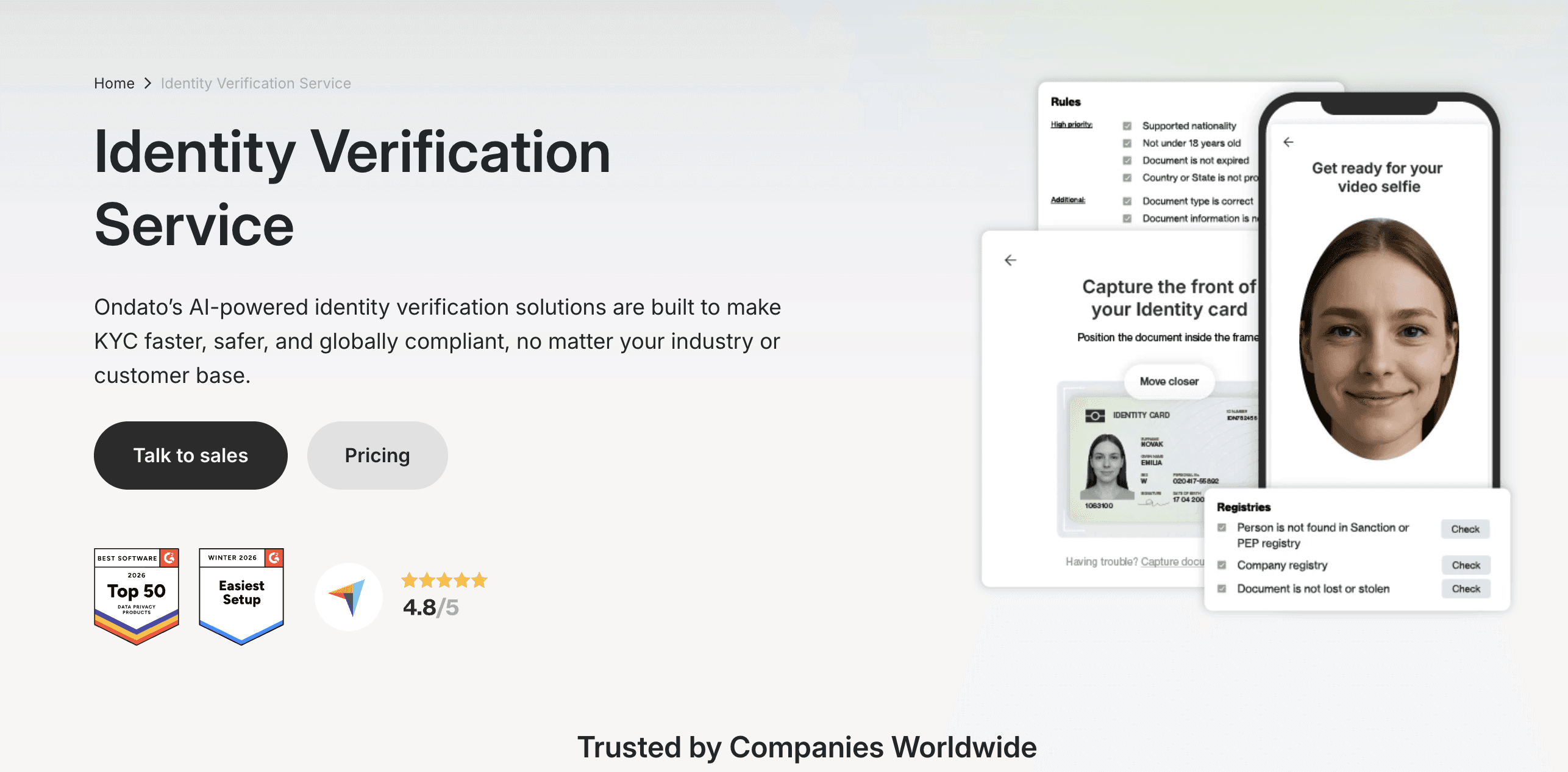
Ondato brings identity verification, business verification, and AML checks together into one platform. It has been recognised on G2 as a strong performer in the AML software category, and it is generally aimed at fast-growing fintechs expanding into new countries.
What It Does Well
Ondato's main strength is that it combines KYC, KYB, and AML monitoring in one place, which cuts down on the work of stitching together separate tools. Its AI-assisted document checks and ongoing monitoring help reduce manual review time, and it offers a hybrid model where most checks are automated but flagged cases get a manual second look, which fits well for industries that need strict, hands-on review for higher-risk cases.
Limitations
Ondato is reviewed and positioned mainly as a verification and onboarding suite, not as a dedicated long-term document and audit-trail system. For businesses whose main need is a deep, multi-year record of compliance documents across many countries, with registry-based verification at the centre of it, Ondato's strength in unified onboarding should be weighed against how well it supports that longer-term recordkeeping need specifically.
Comparison Table: SpeedyDD vs. Sumsub vs. Trulioo vs. Binderr vs. Ondato
Feature | SpeedyDD | Sumsub | Trulioo | Binderr | Ondato |
|---|---|---|---|---|---|
Data source coverage | 3000+ registry sources across 200+ countries and territories | 14,000+ document types across 220+ countries | 450+ data sources across 195 countries | Not independently specified | Not independently specified |
Core focus | Continuous KYB, due diligence, and audit-readiness | Fast onboarding decisions for KYC, KYB, and AML | Broad global identity and business verification | Configurable KYB onboarding with strong market research behind it | Unified KYC, KYB, and AML suite |
Workflow style | Jurisdiction-aware, risk-based KYB workflows | No-code workflow builder by country and risk level | No-code workflow builder by country and risk level | Configurable onboarding flows by business type, country, and risk | Hybrid automated and manual review workflows |
Best suited for | Multinational regulated businesses needing registry-verified, audit-ready records over time | Fast-moving fintech and crypto businesses needing quick onboarding decisions | Large enterprises needing wide country coverage | Businesses wanting configurable onboarding backed by strong industry research | Fast-growing fintechs wanting one combined compliance suite |
Standout strength | Depth of registry-verified data and built-in audit trail | Speed, automation, and Travel Rule support for crypto | Breadth of country and data source coverage | Strong understanding of the wider KYB market and its gaps | Combining KYC, KYB, and AML in one product |
Worth checking before you buy | Not built as a general document store outside compliance use cases | Stronger at fast decisions than long-term document history | Built for verification first; long-term recordkeeping may need extra tools | Less independently confirmed detail on document storage and audit trail depth | Positioned mainly as a verification suite rather than a long-term audit-trail system |
How to Choose the Right Platform for Your Team
The right choice depends on what your compliance programme actually needs to prove, not just how smooth you want the onboarding experience to feel. If speed and a clean signup flow are your top priority, Sumsub, Trulioo, and Ondato all have strong, proven track records, particularly in fintech and digital-first businesses.
If your priority is staying audit-ready across the entire life of a business relationship, including registry-verified ownership checks, country-specific document rules, automatic renewal reminders, and a record you can pull up instantly for any counterparty, that points toward a platform built around audit-readiness as its main job, not just a fast yes-or-no check at signup.
For regulated businesses managing relationships across borders under changing rules like the EU's AMLR, the US Bank Secrecy Act, and frameworks in Singapore and Australia, the question that matters most is simple: can you prove, for any counterparty, what was checked, when, and by whom? That is the exact problem SpeedyDD is built to solve, which is why it tops this list for regulated businesses whose compliance needs go well beyond the moment someone signs up.
Conclusion: The Platform You Pick Shapes the Audit You Get
A document management platform is not just a place to keep files. It decides whether your compliance team can prove its work or only describe it. The five platforms in this guide all serve real, proven needs in the compliance world, but they are not the same thing, and the differences show up clearly the moment a regulator asks the one question every compliance programme eventually has to answer: prove it.
Choosing a platform built from day one around real, verified records, rather than trying to add that capability onto a tool designed for speed, is what decides whether your team can produce proof on demand or has to scramble to find it under pressure.
Frequently Asked Questions
What should I look for in a compliance document management platform?
Look for verified registry data rather than just self-submitted documents, workflows that adjust based on country and risk level, automatic reminders when documents expire, a clear and timestamped record of every action taken, and the ability to pull up a full, coherent file for any counterparty whenever you need it. Platforms built mainly for fast onboarding may not give you the same depth of ongoing record-keeping that regulators increasingly expect.
Is a KYB platform the same as a compliance document management platform?
Not quite, though they overlap a lot for regulated businesses. A KYB platform focuses on checking a business: confirming who legally owns it and whether it is properly registered. A document management platform is the broader system that stores and tracks all the paperwork generated from that process over time, including renewal alerts and audit logs. The strongest platforms for regulated businesses, including SpeedyDD, bring both of these together so verification and ongoing recordkeeping happen in the same place.
Why does registry-verified data matter more than self-submitted documents?
Under the EU's incoming Anti-Money Laundering Regulation, Regulation (EU) 2024/1624, regulated businesses are required to collect a valid, currently issued registry extract every time they start a new relationship with another company. A counterparty handing over their own incorporation paperwork is a useful starting point, but it is not the same as checking that paperwork against an official, independent source. Platforms that pull data directly from government registries give you a much stronger basis for your compliance decisions and reduce the risk of relying on outdated or incomplete documents someone sent you themselves.
How many countries should a compliance document management platform cover?
That depends entirely on where your business operates and who you are onboarding. If you only deal with counterparties in one country, broad coverage is not your top concern. If you are working across borders, it becomes one of the most important things to check. Some platforms specialise in one region, while others, like SpeedyDD with over 30,000 registry sources across more than 200 countries, are built specifically for global operations. The right answer depends on your own footprint, not a generic industry number.
Can a compliance document management platform help with audit preparation?
Yes, and this should be one of the main things you test before choosing one. A platform built around staying audit-ready generates the proof automatically as your team makes decisions, rather than asking you to piece it together manually when an audit is announced. That includes timestamped records of every document collected, every review completed, every approval made, and every renewal action taken. Platforms that treat documentation as a side effect of onboarding, rather than something they actively maintain, will usually mean a lot more last-minute work when an audit actually happens.
Do these platforms support both KYC and KYB in one workflow?
Most of the platforms in this guide, including Sumsub, Trulioo, AiPrise, and Ondato, let you check both the individual and the business in one flow. SpeedyDD focuses specifically on KYB and business due diligence with deep, registry-verified checks, and many businesses use it alongside a separate KYC tool when they need both individual and business verification in their compliance programme.